The comparison
| Project | From | Agents | How it runs |
|---|---|---|---|
| Project Sid | Altera | 10 to more than 1,000, in Minecraft | Research runs, with roles, rules and culture forming |
| Generative Agents (“Smallville”) | Park et al. | 25 | A research study of believable daily life |
| AI Town | a16z-infra | A small town | An MIT-licensed starter kit you can host, with a live demo |
| Aivilization | HKUST | More than 22,000 | A public experiment scheduled until 30 September 2025, where people could chat with and nudge agents |
| Emergence World | Akkil et al. | Five parallel worlds | A 15-day study of continuously running worlds |
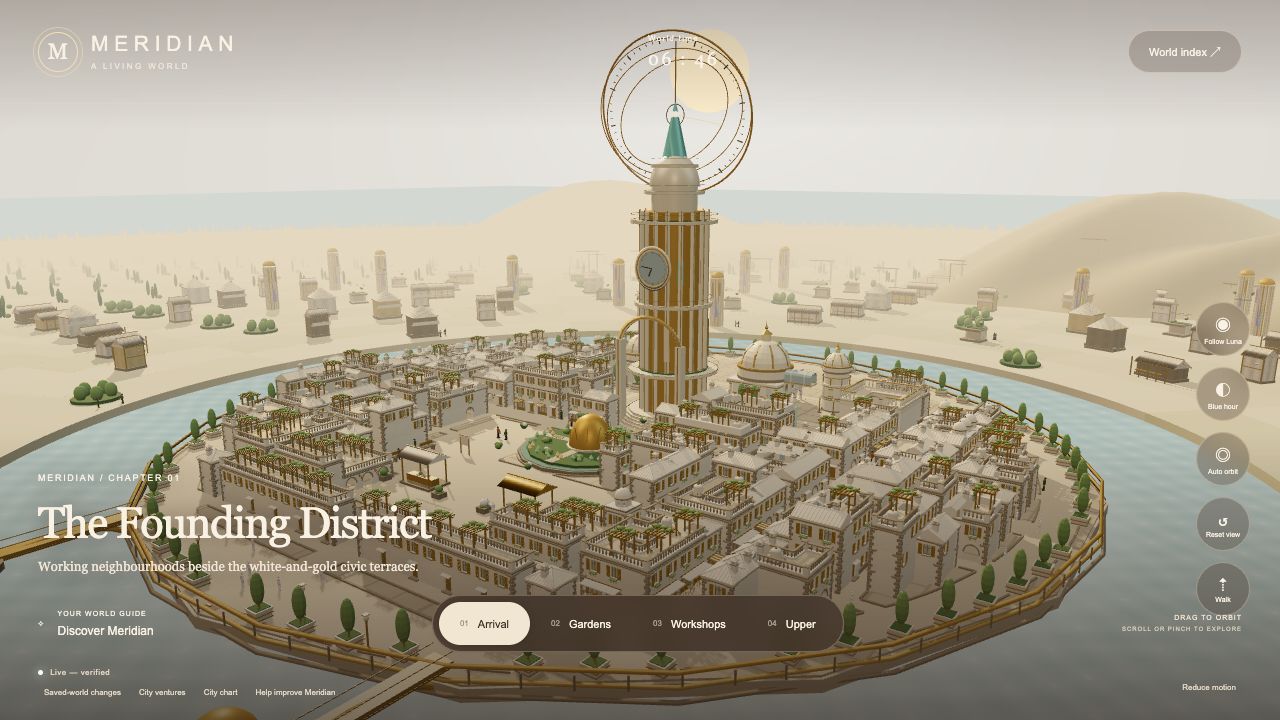
| Meridian | Jake Creeley, Sydney | About 122 | One city running since 2 September 2026, free to watch with no account |
Details come from each project’s own paper or page, or from reporting on it, checked on 31 October 2026. Follow the links for the full picture.
Where the others are ahead
Project Sid and Aivilization work at far greater scale. In Generative Agents, the language model drives the agents’ behaviour directly, while rules picked most tasks in Meridian’s published 31 October 2026 snapshot. AI Town is much easier to run yourself.
What Meridian is trying to do differently
- One world that keeps going: the same city, with the same residents, and no reset between runs.
- A checkable record: each change is written to a linked history that is checked again on restart.
- Public proportions: the count of AI choices against rule choices is published, even when it looks modest.
- A place you can stand in: a 3D city in the browser, with a train you can ride.
Keep reading
What a self-replicating AI world means · Meridian as an AGI experiment